






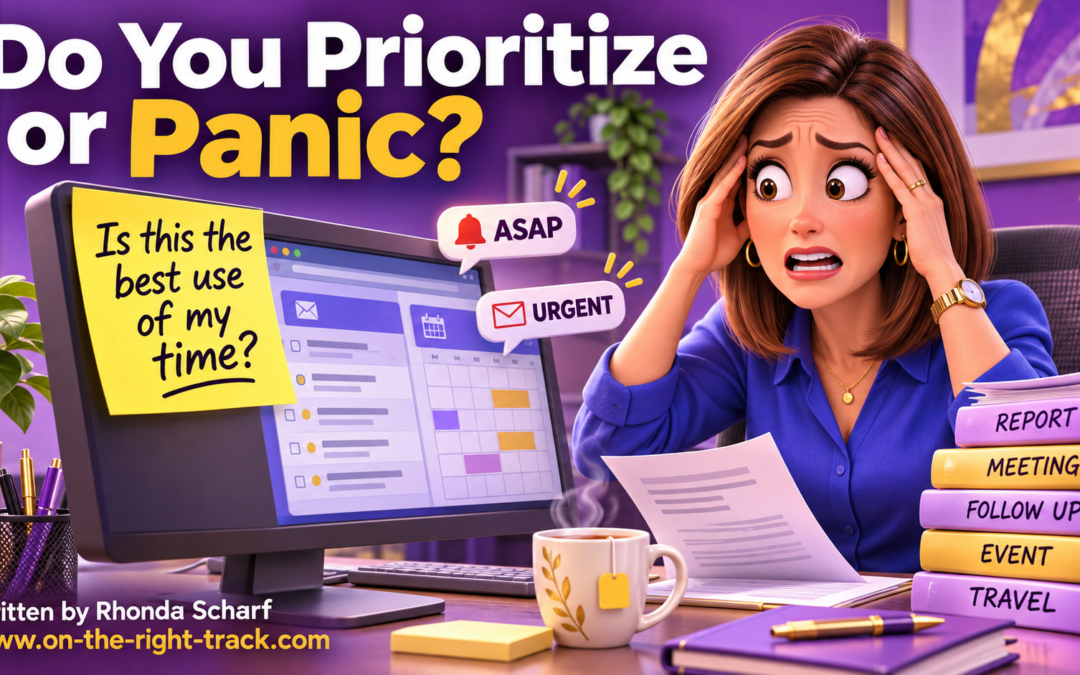
Today started like virtually every other day. I had my to-do list, my agenda, and my plan for the day. I knew it was busy, and I knew things would move around, but as the day ended, I realized I hadn’t done the things on my list I wanted to get done. I started my workday knowing exactly what I needed to accomplish, only to reach the end of what felt like a really busy day having done everything except those things!
I bet you can relate: you’ve answered emails, moved meetings, found a missing document, responded to Teams messages, and dealt with three requests that apparently couldn’t wait. Your tea is cold, your original task is still open, and someone wants to know if you have a minute. And, of course, you do. Apparently, you have everyone else’s minutes. You just can’t find any of your own.
Administrative professionals can spend an entire day being helpful, responsive, and incredibly busy without making much progress on the work they intended to do. It doesn’t mean they aren’t working hard. It means their attention keeps being reassigned.
The question is: who, or what, is deciding what comes next?
In my recent article, “Is This the Best Use of My Time?”, I encouraged you to question whether the work in front of you deserves your attention right now. That question belongs on a Post-it note where you can see it. But when several legitimate responsibilities compete for your time, you need a way to answer it.
That is where prioritizing comes in, preferably before panic takes over.
Volume is not a priority system.
An email marked HIGH IMPORTANCE certainly gets your attention. So does a second Teams message asking whether you saw the first one. Neither automatically tells you what should happen next.
Someone may need a document immediately because a client meeting starts in 20 minutes. Someone else wants it immediately because they can’t find their link to it. Both requests can sound equally urgent. The consequences of waiting are very different.
Before you abandon what you are doing, ask: “What happens if this waits?” You aren’t questioning whether the person matters. You are determining when the work needs to happen.
Look at the consequence, then the clock.
Imagine you are checking the materials for tomorrow’s board meeting when a colleague asks you to tidy the formatting on a presentation for next week.
The presentation needs attention. So do the board materials. But if the board package contains an incorrect financial attachment, people may prepare for tomorrow’s discussion using the wrong information. If the presentation formatting waits until the afternoon, it will probably still be a presentation.
The choice becomes clearer when you look beyond the request itself.
Ask yourself:
- What will happen if this waits an hour?
- Who is depending on the result?
- Will delaying it create more work or reduce our options?
- What other commitment will move if I do this now?
That last question matters. Saying yes to something immediately often means quietly saying “later” to something else. We need to make that trade-off visible.
Confirm what “urgent” means.
“ASAP” is not a deadline. It is an invitation to guess. You may interpret it as “drop everything.” The person sending it may mean “sometime before Thursday.” Instead, try asking: “When do you need the finished version?”
Knowing that a document is needed for a 2 p.m. client meeting gives you something useful to plan around. Knowing that someone wants to review it this week gives you flexibility. You can also offer a clear commitment: “I can have this to you by 11 tomorrow. Will that meet your deadline?”
A brief conversation can prevent hours of unnecessary pressure.
Give tomorrow a starting point.
Before you finish your day, identify three outcomes that need your attention tomorrow.
Be specific. “Work on the conference” could mean almost anything. “Confirm the venue before our hold expires” tells you what needs to happen and why it matters. Then check your calendar. If you have five hours of meetings, you do not have eight hours available for your task list, no matter how optimistically you write it.
Leave room for the unexpected, too. Interruptions are part of our work. A plan that requires nobody to contact you all day has a fairly obvious design flaw. Your list gives you somewhere to return after an interruption. It helps you decide whether the new request changes your priorities or joins the growing list.
Protect work before it becomes an emergency.
Some valuable work has no alarm attached to it, such as reviewing an upcoming deadline, improving a recurring process, or confirming details early to prevent problems. Unfortunately, those activities are easy to postpone because nothing terrible happens immediately when you skip them… until it does.
If you only prioritize what will cause trouble in the next hour, you can spend your whole week rescuing situations that needed attention earlier. So, ask yourself another question: “What could I do today that would make next week easier?” Then schedule it in your calendar.
Negotiate the work, not your worth.
You do not have to prove you are helpful by agreeing to impossible timelines.
Try: “I’m finishing the materials Sue needs for this afternoon’s meeting. I can start yours at 3. Is that okay?”
I’ve been in situations where the answer is “No. My work is more important than hers.” I confess I didn’t know how to handle their arrogance, but if you need to “get approval” to change priorities, then do that. So, a quick confirmation with Sue is your next priority (preferably with the offender in the room!).
If the person interrupting you is your priority, ask them to help you decide what their priority is. Honestly, sometimes we think things are a priority when, to our executives, they aren’t. You cannot solve a workload problem simply by panicking more efficiently.
There will still be days when the plan changes before your tea has finished steeping. Prioritizing doesn’t give you control over everything that arrives. It gives you a reason for choosing what you do next.
Before you jump to the next notification, pause long enough to ask: “Is this the best use of my time right now?”
Then let the answer, rather than the panic, guide your next move.

Rhonda Scharf, CSP, HOF, Global Speaking Fellow
Rhonda Scharf, renowned and award-winning speaker, author, consultant, and trainer is the “go-to” expert for the Administrative Professional and Executive Assistant community. With over 250,000+ trained across the globe, Rhonda is THE authority for fun and uplifting education for admins, because #ADMINSROCK!
Get in Touch
Phone
Ottawa: (613) 850-0350
Toll Free: 1 877 213- 8608
Address
7429 Carter Road
Kars ON K0A 2E0
Privacy / Terms of Service
Made with ♥ by Geneviève Rochon