



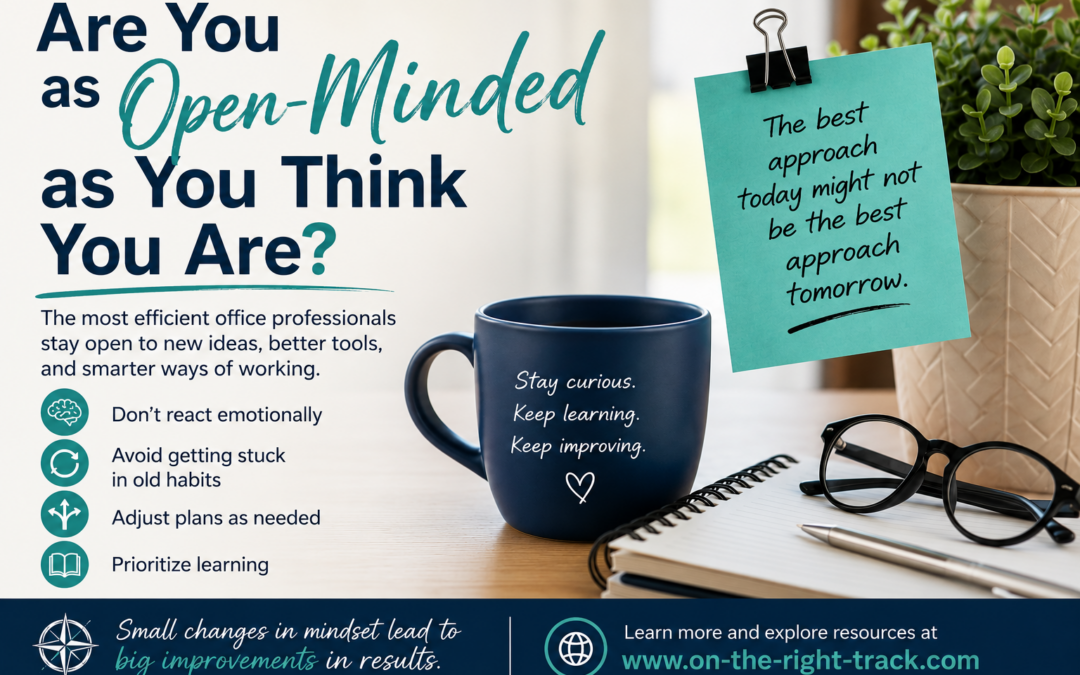
I was recently delivering a workshop, and one of the participants was sharing with the room how important it was to be open-minded at work. Everyone agreed, but it was clear that not everyone actually was open-minded.
How many times a day do you hear, “Oh, we don’t need that. This way has worked for years,” which we recognize as the “if it isn’t broken, why fix it?” approach to life. Or when someone shares a new app or program they use, the immediate response is that there isn’t time to learn it.
When we think about the most efficient office professionals, we often focus on their organizational skills, attention to detail, and ability to juggle competing priorities. Those qualities certainly matter. But there is another trait that quietly separates exceptional admins from the rest: open-mindedness.
Are you really open-minded?
Open-mindedness is about being willing to reconsider assumptions, explore new approaches, and adapt when circumstances change. It’s a mindset, and honestly, one of the most valuable professional skills you can develop.
Every once in a while, I’ll watch an online video about a new way to do something I have done for years (like cooking or cleaning). My routines, recipes, and approaches work very well. And when I see new approaches, I often wonder, “Why would you do it that way?” I have been guilty of falling into the “if it isn’t broke, don’t fix it ” thinking in both my personal and professional life. I’m guessing you have some areas in life where you are guilty of thinking that way, too. Sometimes our routines work well. We create systems, processes, and habits that help us manage our workload efficiently. I know that those habits can become automatic. The danger is that we may continue using them long after a better approach exists.
However, like you, I need to recognize both in and out of the office that while my experience is valuable, it shouldn’t stop me from learning new things. We should routinely challenge ourselves to learn new things. Experience is valuable, but it should never become a barrier to improvement.
Do you regularly ask yourself:
- Is this still the best way to do this task?
- Could technology simplify this process?
- Am I doing this because it is effective, or because it is familiar? Familiarity and effectiveness are not always the same thing.
That willingness to challenge what you’ve always done is important for growth. So here are some habits that open-minded people possess.
- They Don’t React Emotionally
When a process changes or a new tool is introduced, pay attention to your initial reaction. Do you immediately resist, come up with reasons why this new process won’t work, or how much extra work it will cause you to learn the new process or tool?
In my workshop referenced above, we shared AI tools. One of the attendees asked, “What does this do that I can’t do with CoPilot?” That’s a much better question than saying, “I don’t need another new tool to do something I know how to do quickly” or “My current way is good enough, and I don’t need more options” without even looking into what it can do.
That shift in perspective allows you to evaluate changes objectively rather than emotionally. Our initial reaction is often ‘No!’ But that’s emotion talking. Before rejecting an idea, pause and ask a question. Curiosity almost always leads to better decisions than resistance.
- They Avoid Getting Stuck in Old Habits
Every one of us has routines that feel comfortable. Perhaps you have always organized meetings a certain way, managed files in a particular system, or written your email signature line a certain way.
I’m the same, but I realize that comfort is not the same as effectiveness, and I make it a point to look at how and why I do things. In fairness, this is part of my job, and what I love, but when I find bottlenecks, redundancies, and ways to streamline, I am motivated. I have a magnet on my fridge that says, “There must be a spreadsheet for this,” which makes me laugh.
While I like finding new ways of doing things, I appreciate that not everyone does. We do need to be aware of when we are stuck in old habits and ask ourselves if this is the most efficient way to do it moving forward.
I joke about functions in Excel and how many of us don’t use them, but instead just put the correct answer in the cell. That works great until the spreadsheet changes, and then we have to start over and recalculate the answers. I joke about it because so many people admit to doing that! While having to start all over is rare, it still isn’t logical to calculate each cell manually (or blend names manually), but you’ve done it for so long that you justify why you don’t bother learning how to write the formula.
- They Adjust Plans as Needed
Rigid thinking can be costly. Priorities shift, directions change, and unexpected issues arise daily.
Open-minded professionals are flexible. They can pivot without feeling that a change in plans is a personal failure or thinking that someone changed the goal just to mess with their day.
Their goal is not to prove that their original plan was perfect. Their goal is to achieve the best possible outcome.
And yes, the last decade has taught us to adjust as needed, and yes, there are still people complaining about it. We do need to adjust, whether we like the adjustment or not.
- They Prioritize Learning
One of the most powerful mindset shifts is moving from “I need to sound like I know what I’m doing” to “I need a better approach.”
Too many of us feel like we should always know the answer. I’m not sure why we feel that way, but we feel like we shouldn’t say, “I don’t know.” In reality, the strongest professionals are often the ones willing to admit when they don’t know something.
Consider these two responses:
- “This still works, and it’s how we’ve always done it.”
- “I’m not sure this is the most effective approach anymore. Let’s explore alternatives.”
The second response demonstrates curiosity, humility, and a commitment to improvement. Those qualities build credibility, not diminish it. And if you just said to yourself, “But I don’t have time to do that all day long,” then you need to recognize that you are not as open-minded as you could/should be.
It’s too easy to make excuses, and in fairness, many of them feel completely valid. But, one day, they won’t be valid anymore as the “old” way is taking much too long to complete.
This week, take a few minutes to reflect on your own work habits. Ask yourself:
- What is one task I perform regularly that I haven’t reevaluated in years?
- What assumptions do I hold about how my work “should” be done?
- Are there technologies, tools, or processes I have resisted without fully exploring their potential?
- When was the last time I changed my mind about a professional practice because I discovered a better way?
You may discover that some of your most time-consuming activities are based on habits rather than necessity. It is highly uncomfortable to question our long-held beliefs. It means we need to acknowledge there might be a better way than what we’ve been doing. However, when we do question ourselves, we do get better!
By staying open-minded, you are remaining curious, adaptable, and willing to learn. You understand that excellence is not a fixed destination. It is an ongoing process of refinement.
So here is my challenge to you: What is one old habit, assumption, or strategy in your work that is worth questioning? You don’t need to change everything overnight. Start with one area where you are willing to ask, “Is there a better way?”
That single question may be the beginning of your next level of professional effectiveness.
Rhonda Scharf, CSP, HOF, Global Speaking Fellow
Rhonda Scharf, renowned and award-winning speaker, author, consultant, and trainer is the “go-to” expert for the Administrative Professional and Executive Assistant community. With over 250,000+ trained across the globe, Rhonda is THE authority for fun and uplifting education for admins, because #ADMINSROCK!
Get in Touch
Phone
Ottawa: (613) 850-0350
Toll Free: 1 877 213- 8608
Address
7429 Carter Road
Kars ON K0A 2E0
Privacy / Terms of Service
Made with ♥ by Geneviève Rochon