



Lately, I have noticed a common theme in my conversations. People are overwhelmed. Not the “I need a nap” kind of overwhelmed. The deep, bone-tired, mentally overloaded, where-even-do-I-start kind.
And honestly? I feel the same.
Some days it feels like the weather alone is enough to push us over the edge. Grey skies that drag on forever. Cold when we want warmth. Heat when we want relief. Add in political upheaval that seems to change by the hour, workplaces that feel like they are constantly restructuring, new technology landing on our desks faster than we can learn the last one, and workloads that keep growing while headcount stays exactly the same.
It is a lot. And pretending it is not does not help anyone.
There are mornings when I open my laptop, look at my calendar, glance at the news, check my email, and think, “Well. This is ambitious. What was I thinking when I thought I could get all this done?” I have had days where I am incredibly busy but feel like I have accomplished nothing meaningful. I have also had moments where I catch myself sighing dramatically at my screen, as if it personally created all my problems.
If you have been there, you are not weak. You are human.
Overwhelm often shows up when too many things feel out of our control at the same time. Weather we cannot change. Decisions are being made far above our pay grade. Expectations that keep shifting. Deadlines that do not care how we are feeling. When everything feels urgent, our nervous system struggles to tell the difference between real danger and an overflowing inbox.
So, what do we do when life feels like it is piling on?
We start by being compassionate with ourselves. That sounds simple, but it is surprisingly hard. Many of us are very good at giving grace to others and absolutely ruthless with ourselves. We tell ourselves we should be handling it better. We should be more organized. More resilient. More positive. More something.
But overwhelm is not a personal failure. It is often a signal.
One of the most helpful tools I keep coming back to is the Circle of Control, which I learned from Stephen Covey. If you have heard me talk about this before, it is because it works.
Picture three circles. The outer circle is everything you care about. The weather. The impact politics has on your life. Organizational changes. Other people’s reactions. The economy. The decisions your leadership team makes without asking you.
The middle circle is what you can influence. How you communicate. How you prioritize. How you show up.
The inner circle is what you can control. Your actions. Your boundaries. Your mindset. Your responses to the things that you care about.
When I am overwhelmed, I usually realize I am spending far too much energy in that outer circle. I am mentally rehearsing conversations that have not happened. I am worrying about outcomes I cannot control. I am absorbing stress that does not belong to me.
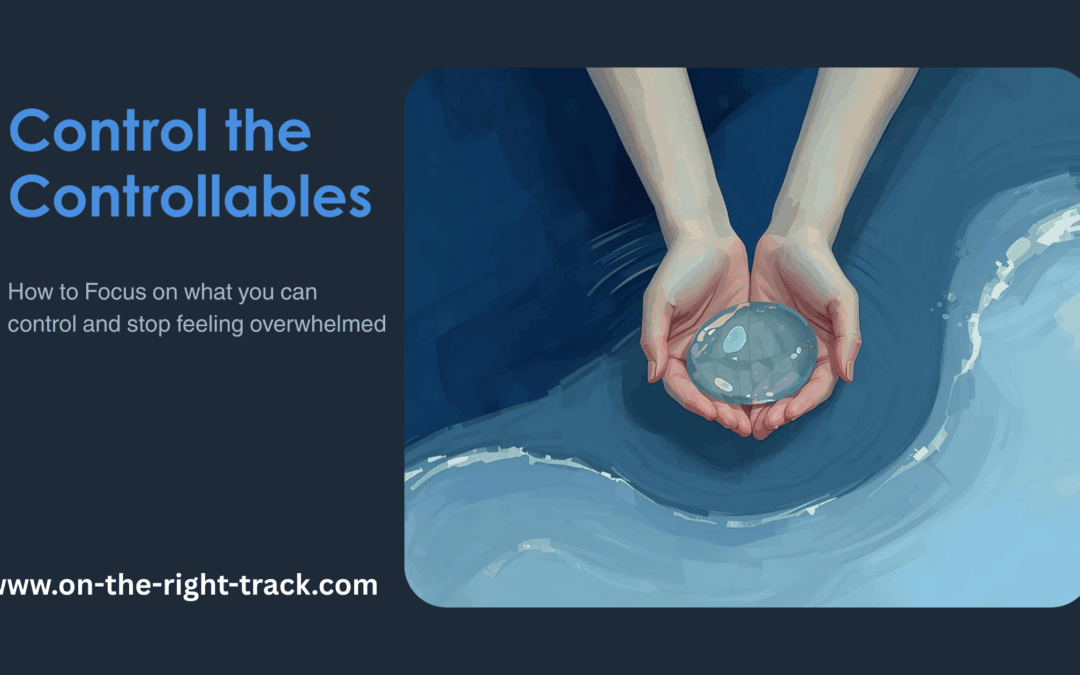
Control the controllables.
That does not mean ignoring reality or sticking your head in the sand. It means choosing where your energy goes. You cannot control the volume of work landing on your desk, but you can control how you triage it. You cannot control constant change, but you can control how you document processes, ask questions, and protect your focus. You cannot control the news cycle, but you can control how often you consume it and when you step away.
One practical thing that helps is doing a quick inventory of overwhelm. Write down everything that feels heavy right now. All of it. Then draw a line down the page. On one side, write “In My Control.” On the other, write “Not In My Control.” Be ruthless and honest. Then ask yourself one simple question. What is one small action I can take today that sits firmly in my control?
Not ten things. One.
Sometimes that action is clarifying priorities with your manager instead of guessing. Sometimes it is blocking thirty minutes of uninterrupted time on your calendar. Sometimes it is saying no, or at least not right now. And sometimes it is closing your laptop, going for a walk, and reminding yourself that rest is not a reward for finishing everything. It is a requirement for functioning.
I also want to say this clearly. Being motivated does not mean pushing through at all costs. Real motivation comes from feeling capable, not crushed. From knowing that while you cannot control everything, you are not powerless.
If you are feeling overwhelmed right now, you are not behind. You are not failing. You are responding to a world and a workplace that asks a lot.
So this week, be kind to yourself. Notice where your energy is leaking. Pull it back into your circle of control. Do one thing that helps you feel steady again. Even if that thing is small.
Especially if it is small.
You have more control than it feels like on the hard days. And you do not have to do everything to move forward. You just have to do the next right thing.
And maybe sigh at your screen a little less. Or at least laugh when you do.