








We all know someone who seems to delight in pushing buttons. They play music too loud. They make passive-aggressive comments. They send that one-word email reply that clearly means more than it says. They “accidentally” leave you off a meeting invite or throw something over the fence; literally or figuratively.
And let’s be honest: it’s hard not to react.
But when we do react—especially when it’s what they want—we give away our power. We lose control of the situation and, more importantly, control of ourselves. Whether it’s your neighbor, a difficult colleague, or a relative at a family dinner, rising to the bait only feeds their behavior.
So how do we not react when someone clearly wants a reaction?
Why People Push Buttons
At the heart of it, people often provoke others because:
- They want attention.
- They want control.
- They feel powerless themselves.
- They want to distract from their own behavior.
- They enjoy the drama.
In the workplace, it can look like a colleague undermining you in a meeting, taking credit for your ideas, or excluding you from an email chain. At home, it might be the neighbor blasting music at night, or your mother-in-law who always makes snide comments.
These provocations are often deliberate. They aren’t random acts. They’re designed to see how you’ll respond.
I’ve shared before how my husband, Warren, and I had those exact neighbors. They played the music at full volume, especially when we were sitting outside. They would throw dead branches over the fence, and they made very loud, passive-aggressive comments daily.
Last summer, Warren and I were sitting outside listening to their chirping (which was about Warren the previous day), and I kept repeating to him, “Don’t react. He is doing this to get you to react. Don’t react.” It’s tempting to call out their childish behavior. It’s tempting to fight fire with fire (or unprofessionalism with unprofessionalism).
Warren isn’t the only one who shouldn’t react. Our neighbor wanted Warren to react. If they didn’t want him to hear what they were saying, they would have lowered their very loud voice. If you react you are giving them what they want.
When you are left out of meetings, not included in conversations, or take credit for your ideas, they know you will see it happening. They want you to react and look unprofessional or childish. So, the question becomes: Will you give them what they want?
Reclaiming Your Power: The Art of Non-Reaction
Not reacting doesn’t mean you’re weak. It doesn’t mean you’re ignoring the issue. It means you’re choosing a response rather than letting the other person dictate your behavior.
Here’s how to stop taking the bait:
- Recognize the Game
The first step is awareness. When someone behaves in a way that seems oddly targeted, such as too petty, too perfectly timed to push your buttons, it probably is. Recognize the behavior as bait. This is not about solving a real issue. It’s about getting you to react.
Think of it like fishing. The fish doesn’t get caught because there’s a hook. It gets caught because it goes for the bait. You can see the bait and swim right past it.
- Pause Before You Respond
Reaction is immediate. Response is intentional.
You don’t owe anyone a fast reaction. That snarky comment in a meeting? You don’t have to jump in. That nasty email? It can wait until tomorrow. That fence-thrown object? You don’t have to acknowledge it at all.
A pause buys you time to decide how you want to respond, or if you want to respond at all.
- Respond Calmly, If at All
When someone is trying to get a rise out of you, nothing confuses them more than calm.
One day last summer, we came home to our neighbor having an outdoor fire (a very smoky fire), and you guessed it, I had laundry hanging on the line. I went outside calmly, took down my laundry, and said nothing. I didn’t mutter, I didn’t run, I didn’t do it any differently than if there wasn’t a smoky fire ruining my work. Then, after that was done, we started a fire too (we had a lot of paper to burn, and it seemed like a good idea).
I knew this would frustrate them. I made it look like having a fire was a great idea, which is not why they had a fire at all! I didn’t feed their negative energy and responded very calmly by taking my laundry down.
At work, a nonchalant “Thanks for your input” in a meeting, or a polite smile and change of topic at dinner, can be infuriating to someone seeking drama. Don’t raise your eyebrows to a colleague, and don’t mutter under your breath.
Don’t feed the energy. Respond with neutral professionalism in the workplace and bland indifference at home. Think of it as emotional judo, using their momentum to render their attack pointless.
- Don’t Match Their Energy
When you feel negative energy, it is pure instinct that makes you match it back. Someone snaps at you or is rude? You snap back. But when you match their level, you legitimize it. You join the game, and you give them what they wanted in the first place.
In both professional and personal settings, it’s crucial to hold your line. You don’t have to match pettiness with pettiness, rudeness with rudeness, or loud with louder. You’re better than they are. Show them that.
I don’t want to be influenced by the negative energy our neighbors have. That’s not who I want to be.
Let them escalate alone.
- Set Boundaries, Privately and Firmly
Non-reaction doesn’t mean being a doormat. If someone’s behavior crosses a line, you are absolutely entitled to set boundaries, but do it on your terms.
Instead of yelling over the fence, you document the behavior and contact bylaw services. Instead of a public call-out at work, you schedule a quiet conversation with your manager or HR. You stay calm and professional, and you act strategically.
Don’t match their noise. Outsmart it.
- Feed What You Want to Grow
This is key. Every time you react to bait, you reinforce the behavior. Every time you stay calm and centered, you make that tactic less effective.
In a work setting, this might mean reinforcing collaborative and respectful behavior while ignoring drama. At home, that might mean focusing your energy on peaceful interactions and not rewarding antagonism with attention.
Water what you want to grow. Ignore the weeds.
- Play the Long Game
People who thrive on getting a reaction will eventually get bored if they’re consistently ignored or met with calm neutrality.
They might escalate temporarily. That’s okay. You hold your line.
You’re not playing to win today’s argument. You’re building long-term credibility, peace, and power. Especially in professional settings, your reputation for grace under pressure is more valuable than any short-term victory.
When someone is fishing for a reaction, you don’t have to bite. You are not obligated to participate in every argument you’re invited to. You are not required to take on someone else’s drama, noise, or pettiness.
You get to decide what you feed, what you fuel, and where your energy goes.
So the next time someone throws something across your fence—literally or figuratively—don’t pick it up and throw it back.
Let it sit. Let them wonder why it didn’t work this time.
Because you’ve learned the art of not rising to the bait.
This article first appeared in Executive Support Magazine.
Ask yourself the following five questions. Answer honestly..
- Do I actively look for ways to improve my skills?
Do you attend webinars, read articles, learn new software, or seek training even when it is not required? - Do I think about where this profession could take me?
Do you ever consider what your role might look like in a few years or how you might grow within the profession? - Do I volunteer for opportunities or projects?
When something new comes up at work, do you raise your hand or wait to see who gets assigned? - Do I see myself as part of the administrative profession?
Do you identify with the profession, connect with other admins, or follow developments in the field? - Do I invest time in my professional development?
This could be conferences, workshops, networking, certifications, or learning from other professionals.
Your Results
Give yourself one point for each “yes.”
0 to 1 Yes
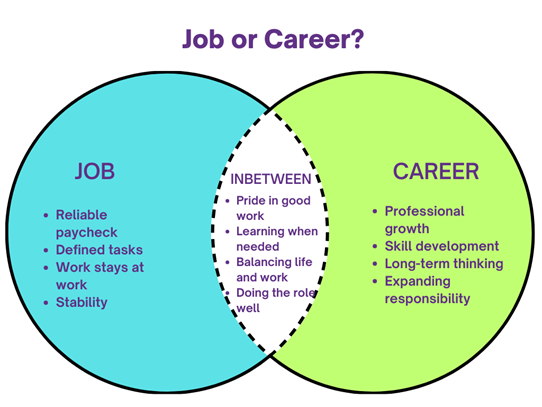
You likely have a job, and there is nothing wrong with that. Work may simply be something that supports the rest of your life. As long as you are satisfied with that arrangement, you are exactly where you want to be.
2 to 3 Yeses
You are probably living in the middle of the Venn diagram. You care about your work and occasionally invest in it, but it may not be something you are intentionally building as a long-term career. Are you comfortable with the in-between phase? Did you think you were building a career, only to realize you haven’t been?
4 to 5 Yeses
You likely see administrative work as a career. You are investing in your growth, thinking about the future, and actively building your professional value.
It isn’t my goal to convince everyone to turn their job into a career. My goal is awareness.
If you want a career, you need to nurture it. Careers grow through learning, networking, training, and sometimes stepping outside your comfort zone.
If you are happy having a job that allows you to support the life you want outside of work, that is also a perfectly respectable choice.
But knowing the difference helps you make intentional decisions about your time, your energy, and your future.
So take a moment and ask yourself:
Is this a job?
Or is this a career?
Once you know the answer, you can decide what you want to do next. I know that, over the years we have been awarding the Canadian Administrative Professional of the Year, each of our winners has had a career. And they are proud and happy in it!