








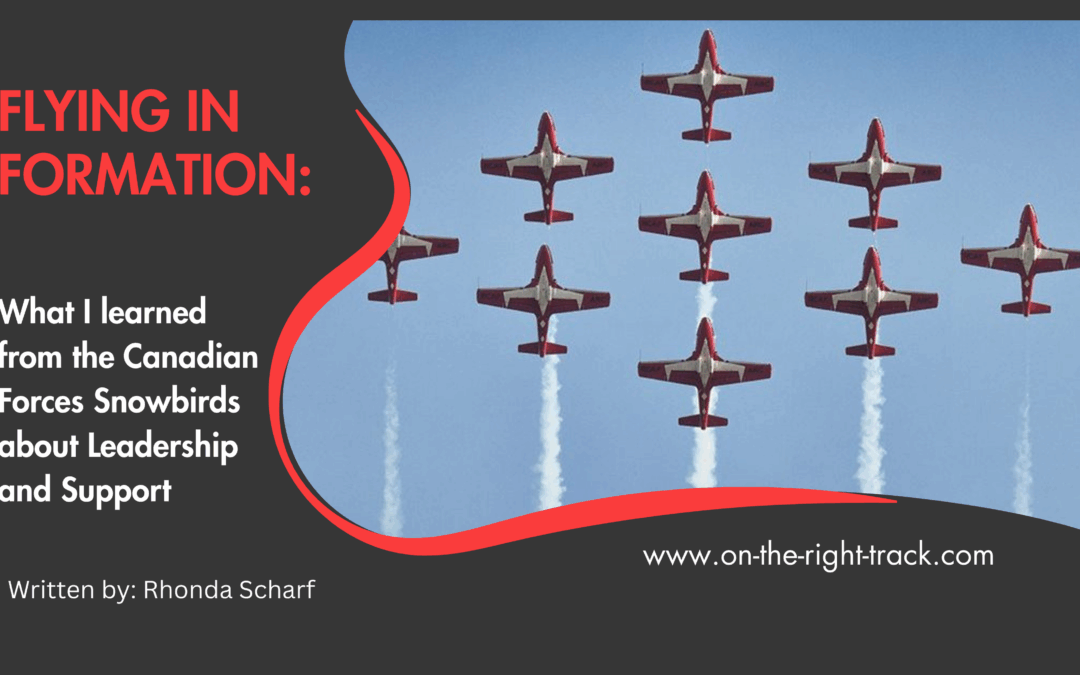
I recently attended an airshow where the Canadian Forces Snowbirds performed, and I’ll be honest, I was utterly captivated. I’ve seen many flyovers in the past at events and football games, and while they are impressive, I’d never seen the entire show before. It was amazing!
As the nine planes roared overhead, I couldn’t take my eyes off them. They flew so close together that it felt impossible. I found myself holding my breath as they twisted into impossible shapes and then snapped back into perfect formation. You could hear the collective gasps as everyone held their breath at the same time, and the cheers were energetic.
It felt like magic.
But as I stood there, I reminded myself that it wasn’t magic at all. It was discipline. It was trust. It was precision. It was teamwork.
And the more I watched, the more I realized: what the Snowbirds do in the air is exactly what administrative professionals do on the ground every single day.
I noticed that every maneuver started with the lead plane. All the others adjusted themselves based on the leader’s movements. Our host for the evening was regaling me with stories about the Snowbirds and told me that the pilots don’t look at where they are going, nor do they look at one another. Their eyes are locked onto that leader, trusting them and the direction completely.
As administrative professionals, we have the same role. Our “lead plane” is usually our executive. Our job isn’t to mirror what everyone else is doing, but to stay aligned with their priorities and direction. That’s what keeps everything flying smoothly.
Watching the planes fly just feet apart made my stomach tighten. I was told they are sometimes only 18 inches apart! At that speed, that close, trust is not optional but life or death! Each pilot has to trust that the others will stay exactly where they should be.
I realized how similar this is to the relationship between an executive and an admin. We work in close quarters, too. Our leaders must trust that we’ll anticipate needs, protect their time, and keep them on track. And we have to trust them enough to do our jobs confidently without second-guessing every move.
Without trust, the formation simply won’t hold.
From the ground, the performance looked effortless. But I knew it wasn’t. The Snowbirds train endlessly so that every twist and turn becomes second nature. That’s why they can make something so dangerous look so graceful.
Isn’t that what we do, too? When you’ve spent years perfecting your systems, honing your organizational skills, and developing your instincts, you make the complex look easy. Running meetings, juggling projects, and handling last-minute changes look effortless to others, but it’s only possible because of the training and discipline behind it.
There were moments during the show when crosswinds came through, or when the timing was just a little off. I could see the pilots adjust instantly, yet the formation never wavered.
That struck me. Change is constant in our world, too. Meetings move, projects shift, and new priorities land on our desk. Our ability to adjust while still keeping the team and the leader on track is what makes us invaluable. Like the Snowbirds, we don’t panic—we adapt, and the formation stays strong.
One plane doing acrobatics would have been impressive. But nine planes, perfectly synchronized, created something unforgettable.
That’s what we do as administrative professionals. It’s not about us individually—it’s about what we enable others to do. We amplify our leaders, our teams, and our organizations so that together, we can accomplish far more than any of us could alone.
As I left the airshow, I realized that the Snowbirds aren’t magical at all. Their performance is built on clarity, trust, practice, adaptability, and teamwork.
And so is ours.
Administrative professionals may not be flying jets, but we are flying in formation. We’re keeping our leaders on course, anticipating changes, and making the impossible look effortless.
So the next time you feel like your work is invisible, remember this: even the Snowbirds’ magic depends on someone holding formation. Without that discipline, there would be no show.
We may not be in the spotlight, but we are the reason the team can soar.