








Grace Under Pressure: Handling the Frustration You Can’t Control
I love coordinating things. Give me color-coding, multiple schedules and time zones, and every other fly in the ointment you can think of, and I’m happy. It makes me feel like a Tetris Master when I get it all figured out.
Except, as we both know, all this incredible coordination can be unravelled in 30 seconds. Simple things like a flight getting cancelled or delayed, someone rescheduling, a project direction changing, or a miscommunication about daylight saving time, and it all falls apart. And, to make matters even worse, sometimes they completely forget to tell you that the schedule won’t work the way you planned for it to work, or that there was a change involved.
And it’s frustrating, isn’t it? Yep, I may utter a few words that no one should hear me say, I may yell from time to time, but I know that frustration when these things happen is normal, and things changing are inevitable, aren’t they?
We know that curse words and yelling are not the answer, especially if you are in the office where others can hear you. But in that moment, it’s hard to remember what we should be doing.
Fortunately, this week, after a particularly spectacularly frustrating moment, it dawned on me that there is a better way to handle frustration!
- Pause. It’s Not Personal.
When hours of work get scrapped, it is easy to think:
- Why didn’t they tell me?
- Do they not respect my time?
- Does anyone understand how much work that took?
Sometimes those thoughts are valid. But often, the change wasn’t about you at all. It was about shifting priorities, leadership pressure, or information you were not privy to.
The first step is to separate emotion from assumption.
Instead of:
“They don’t value my work.”
Try:
“The situation changed. Let me see what that means for me.”
That tiny mental pivot immediately lowers the emotional temperature. By taking it personally, you are getting more frustrated because your emotions are involved. Take a moment to take a deep breath (or two or three if needed) and remind yourself they didn’t change the schedule just to infuriate you. It feels that way, but logically, you know this isn’t true.
Take a deep breath so you don’t start spiralling into thinking it was personal. It’s not personal.
- Acknowledge the Frustration (Privately)
You are allowed to feel frustrated. I am sure you are often praised for your calm, adaptability, and unflappability. That does not mean you are a robot, and you are allowed to feel frustrated!
If the board binder you finalized at 10:00 pm is no longer needed at the 9:00 am meeting, you are allowed to think:
“Well, that’s irritating.” or “I wish someone had mentioned it long before 10:00 pm!” (with a little sarcasm in your voice). And notice I said, “think” and not “yell”.
The trick is how you process the frustration. You can combine your pause with a five-minute walk to clear your head and ease your frustration, or even go to the gym if the timing is right. You can step away from your desk and go chat with a colleague for a few minutes to distract yourself while you are upset. If you have that trusted colleague, you can vent (for just a few minutes), and for those of you who journal, you can write it all down (just don’t use email and send it to anyone!).
If you stifle your emotions and try to “just get over it and move on,” it shows in your body language, tone, and, of course, your attitude, because you are still angry and frustrated on the inside.
Because once frustration leaks publicly, it can damage your reputation. Ignoring it won’t help you long term, so acknowledge that you are frustrated. In a way that won’t damage your reputation.
- Shift From “Wasted” to “Repurposed”
Words matter, and this is a powerful reframe of the words we use. While you may feel that your time was wasted, very little work is truly wasted.
Think about the schedule you took time to create. You likely noticed some patterns in your team’s priorities. The PPT presentation masterpiece you created can easily be repurposed for another presentation. And that research you did, you likely learned something, and knowledge is always useful. It may have felt like it was wasted, but it wasn’t.
Instead, let’s change the language we use when we speak to ourselves.
When I hit my wall of frustration this week, I told myself I had wasted a lot of time and energy. When I took time to think about it, I realized that I learned an important lesson, and I guarantee this situation won’t ever happen to me again. I now have another option on my checklist for the next time I’m doing that task. That wasn’t wasted time for me; it was preventive for the future.
When we feel that we wasted time, our frustration makes us want to blame someone. However, when we take control of how we see the situation, we feel more in control.
- Control What You Can Control
I have been writing about this a lot recently. We are involved in a lot of moving parts in the office, but we often don’t have control over the decisions.
But there are things that we can control. We can control how we handle the situation (our response), how we communicate when things go sideways (don’t send that email you want to send!), your systems (update your templates and checklists so this doesn’t happen again), and your boundaries (so you don’t feel taken advantage of!).
Frustration often signals a systems gap.
Instead of simmering, ask yourself what small process tweak could prevent or identify this the next time it happens. You won’t eliminate change, but you may reduce some of the chaos by improving your process.
- Build Frustration Resilience
Resilience is not about never being annoyed. It is about shortening the recovery time.
Find ways to make yourself feel better when these things happen so you can recover faster. Do things like keeping a “kudos” file to remind yourself when things go well, or ensuring you always protect your energy by not burning the candle at both ends. If we look at the situation practically, we can put it into perspective, too. In most cases, no one is in danger. It is a calendar shift, not a crisis. So when we feel ourselves overreact, we can put it into perspective.
You are in a role that requires agility, diplomacy, and emotional intelligence.
Anyone can manage a static plan. It takes a professional to manage constant change with grace.
Every time you handle these situations with grace, you build your reputation. Every calm response strengthens trust. Every time you say, “No problem, I’ll adjust,” and mean it, you increase your value.
Invisible frustration, processed maturely, is often what distinguishes senior-level professionals from everyone else.
We all know that frustration at work is unavoidable when you operate in environments where you are not the final decision-maker. That doesn’t mean you need to become angry and bitter when it does happen.
Because anger and bitterness are optional. Instead, handle this frustration with grace. You can pause, take a break, and realize it isn’t personal. Every time it happens, you have the opportunity to show your organization that you are calm and can handle whatever comes your way.
In the meantime, I’ll still enjoy creating and coordinating the impossible. And when it all gets turned upside down, I’ll know that those are my moments to shine because I’ll stay calm and professional and make it perfect again.
And remember: your real superpower is not flawless planning. It is a calm recalibration.
And that is something no last-minute change can take away from you.
Ask yourself the following five questions. Answer honestly..
- Do I actively look for ways to improve my skills?
Do you attend webinars, read articles, learn new software, or seek training even when it is not required? - Do I think about where this profession could take me?
Do you ever consider what your role might look like in a few years or how you might grow within the profession? - Do I volunteer for opportunities or projects?
When something new comes up at work, do you raise your hand or wait to see who gets assigned? - Do I see myself as part of the administrative profession?
Do you identify with the profession, connect with other admins, or follow developments in the field? - Do I invest time in my professional development?
This could be conferences, workshops, networking, certifications, or learning from other professionals.
Your Results
Give yourself one point for each “yes.”
0 to 1 Yes
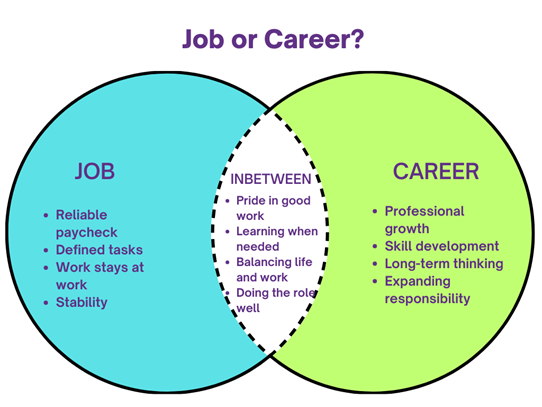
You likely have a job, and there is nothing wrong with that. Work may simply be something that supports the rest of your life. As long as you are satisfied with that arrangement, you are exactly where you want to be.
2 to 3 Yeses
You are probably living in the middle of the Venn diagram. You care about your work and occasionally invest in it, but it may not be something you are intentionally building as a long-term career. Are you comfortable with the in-between phase? Did you think you were building a career, only to realize you haven’t been?
4 to 5 Yeses
You likely see administrative work as a career. You are investing in your growth, thinking about the future, and actively building your professional value.
It isn’t my goal to convince everyone to turn their job into a career. My goal is awareness.
If you want a career, you need to nurture it. Careers grow through learning, networking, training, and sometimes stepping outside your comfort zone.
If you are happy having a job that allows you to support the life you want outside of work, that is also a perfectly respectable choice.
But knowing the difference helps you make intentional decisions about your time, your energy, and your future.
So take a moment and ask yourself:
Is this a job?
Or is this a career?
Once you know the answer, you can decide what you want to do next. I know that, over the years we have been awarding the Canadian Administrative Professional of the Year, each of our winners has had a career. And they are proud and happy in it!