




Years ago, while delivering a workshop on-site at a client’s location, I was invited to tour the offices after they had moved into a beautiful new building and were proud of it. The space was bright, modern, and thoughtfully designed. Collaboration areas replaced rows of cubicles. There were quiet spaces for focused work. The technology was impressive. It was the type of office you would be proud to work in, too.
Then I noticed something curious. Employees were still walking paper forms from one department to another for signatures. While I wasn’t hired to conduct an efficiency audit, I couldn’t help but ask why they weren’t using electronic approvals. I got the confused look and head tilt, and was told that was how they had always done approvals.
The company had invested millions in a workplace for the future while still carrying processes from the past. I smile when I think about it because we’ve all done it.
We don’t just inherit furniture and filing cabinets. We inherit habits, procedures, traditions, and ways of thinking. Some deserve to stay. Others deserve a respectful retirement.
The challenge for every professional today is learning the difference.
We all know our workplaces are changing quickly because we see it every day and feel it in nearly everything we do. Technology is evolving, and artificial intelligence is becoming part of everyday work. Employee expectations continue to shift. Customers expect faster responses and more personalized service. According to the World Economic Forum’s Future of Jobs Report 2025, nearly 40% of workers’ core skills are expected to change by 2030. The organizations that succeed will be those that continuously reskill their people and adapt their processes.
However, that doesn’t mean everything from the past is obsolete. Far from it. I’m still using some of the skills I used in my first full-time job as a receptionist back in 1984!
Some of our best practices have stood the test of time because they work. In 1984, I needed to be dependable, show respect, build trust, deliver excellent customer service, follow through on commitments, and listen carefully before I responded. These aren’t outdated ideas. They’re timeless ones because I still need all of those skills.
The mistake isn’t keeping proven practices. The mistake is assuming every old process deserves to survive simply because it has been around for years.
As office professionals, we are often the keepers of organizational knowledge. We know how things work. We know the history behind procedures. That knowledge is incredibly valuable. But with that knowledge comes responsibility.
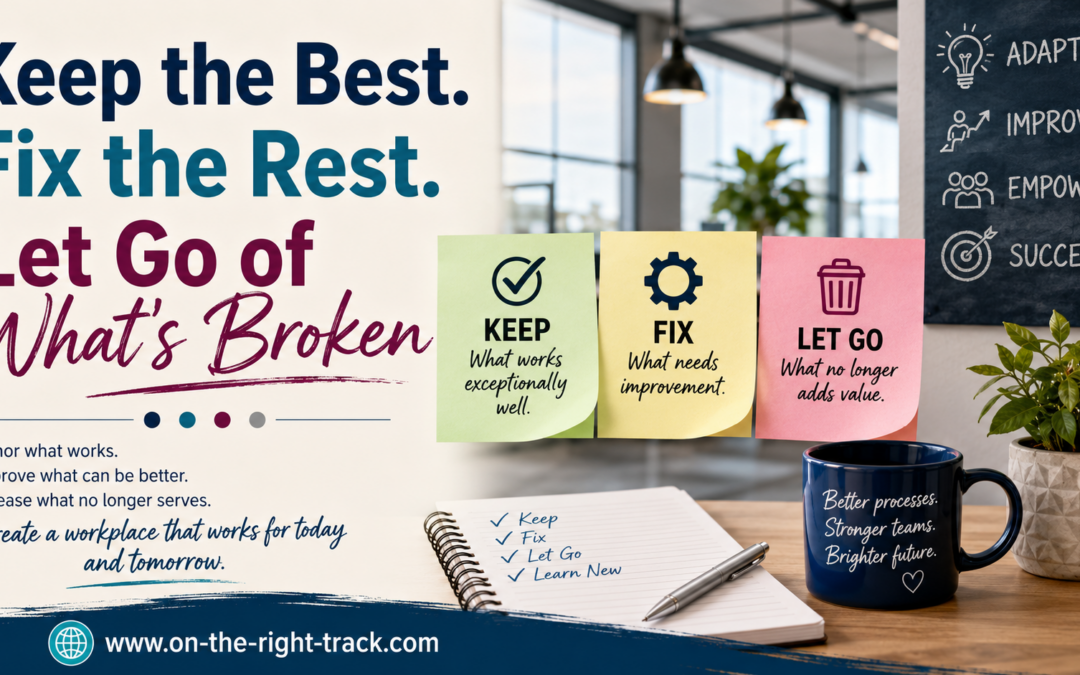
Instead of automatically protecting every existing process, we should be asking four simple questions.
- What should we keep because it still works exceptionally well?
- What should we improve because the environment has changed?
- What should we stop doing because it no longer adds value?
- What new approaches should we learn because today’s workplace demands different skills?
Those four questions can completely change how we approach our work.
For example, perhaps your meeting agendas have always followed the same template. Is it still effective? If yes, keep it. If attendees constantly leave confused, improve it.
Maybe your filing system was designed for paper records. Today, a digital structure may save hours every week. That isn’t disrespecting tradition. It’s respecting people’s time.
Perhaps you’ve always taken detailed meeting minutes that capture every spoken word. But if no one reads them, maybe concise, action-oriented summaries would better serve your team.
The goal isn’t change for the sake of change. The goal is improvement.
But what stops us from changing our processes and routines? Believe it or not, we can feel emotionally attached to familiar routines. Predictable feels comfortable. But comfort doesn’t always equal effectiveness.
Think about your typical getting-ready-for-work routine. What if I asked you to change it? I could suggest showering at night instead of in the morning. You could get up an hour earlier and meditate, or you could drive a different way to work to save 30 seconds in traffic. Did you instantly think of reasons why you don’t need to do those things? Maybe they are excuses, but maybe they are a justification for not making any changes. The problem is that getting ready for work in the morning is a habit you’ve had your entire career. That habit is familiar and comforting. And we generally don’t like changing what feels good.
Research shows that adaptability is becoming one of the most valuable workplace skills. Employers consistently rank flexibility, resilience, curiosity, and continuous learning among the fastest-growing competencies they seek because those qualities allow people to navigate change successfully.
The good news is that administrative professionals have always been remarkably adaptable. We have always needed to be adaptable. That job I had in 1984? It doesn’t exist anymore.
Think about everything you’ve already navigated during your career. Typewriters became computers, paper calendars became digital calendars, fax machines disappeared, virtual meetings became the norm, and cloud storage replaced filing cabinets. Artificial intelligence is now joining the toolkit.
Every one of those changes probably felt uncomfortable at first. Today, many are simply part of your daily routine. I remember teaching admins to switch from their very comfortable Selectric or Memorywriter to a computer terminal. I had a LOT of complaints and questions about why they needed to do that when their current systems were working just fine.
Now, in fairness, I am one of those people who love change. And perhaps that’s why I see change as an opportunity rather than a threat.
Every improvement is a chance to eliminate frustration. Every new skill increases your value. Every outdated process you replace creates more time for meaningful work. Every thoughtful innovation allows you to contribute at a higher level.
Notice I said “thoughtful” innovation. Not every shiny new app deserves a place in your workflow. Not every trend is worth chasing. Wisdom means knowing what to adopt and what to ignore.
The best professionals aren’t the ones who cling stubbornly to the past or abandon everything familiar in pursuit of the newest idea. They’re the ones who thoughtfully combine the best of both worlds. They preserve what still creates value, improve what needs updating, and let go of what no longer serves anyone.
Most importantly, they remain curious enough to embrace better ways of working. That mindset doesn’t just prepare you for the future. It helps you create it.
So, this week, take a fresh look at one process you own. Ask yourself those four questions. What should stay? What needs improvement? What should be retired? What should be added?
You may discover that the greatest opportunity isn’t doing more. It’s having the courage to stop doing what no longer works and make room for what does.
Rhonda Scharf, CSP, HOF, Global Speaking Fellow
Rhonda Scharf, renowned and award-winning speaker, author, consultant, and trainer is the “go-to” expert for the Administrative Professional and Executive Assistant community. With over 250,000+ trained across the globe, Rhonda is THE authority for fun and uplifting education for admins, because #ADMINSROCK!
Get in Touch
Phone
Ottawa: (613) 850-0350
Toll Free: 1 877 213- 8608
Address
7429 Carter Road
Kars ON K0A 2E0
Privacy / Terms of Service
Made with ♥ by Geneviève Rochon