



Our friends, Lisa and Tom were visiting last week. Tom and I were lamenting that we are both terrible sleepers, so Wednesday morning Tom asked me how I slept.
Instead of answering him, I pulled out my phone and said, “Hold on. I’ll check.” Yes, really, and I am not proud of myself. Apparently, I no longer trust myself to know whether I slept well. I need my smartwatch to tell me.
And that’s when I realized something. Maybe we’ve become so obsessed with measuring our lives that we’ve forgotten how to actually live them. I’m convinced we’ve reached the point where some people need an app to tell them if they’re having fun.
Our watches tell us how well we slept. Our phones tell us how many steps we’ve taken. We track calories, water intake, heart rate, productivity, screen time, focus time, recovery time, and probably how many times we’ve blinked this week.
I wouldn’t be surprised if someone invents an app that says, “Congratulations! Yesterday’s laughter exceeded your monthly average by 14%. Keep up the good work.”
We’ve become obsessed with measuring everything.
Now, don’t get me wrong. I’m the last person who’s going to criticize good systems. I make my living teaching people how to work smarter. Administrative professionals are some of the most organized, efficient people on the planet. If there were an Olympic event for color-coded calendars, one of us would be standing on the podium wearing gold.
But somewhere along the way, I think we’ve confused being efficient with actually living. It feels as though every minute has to justify its existence.
Even relaxing has become another item on the to-do list. I KNOW I’m guilty. Are you?
We don’t just read books anymore; we’re trying to hit our annual Goodreads goal. We don’t go for a walk because it’s a beautiful evening; we go because we’re 1,842 steps short of today’s target. We don’t take a vacation because we need a break; we optimize the itinerary to squeeze in twelve attractions before lunch.
A few weeks ago, I spent far too much time researching a new AI tool that promised to save me hours creating my PowerPoint presentations. The irony? I probably spent three hours comparing features, reading reviews, and watching YouTube videos. And I didn’t buy the program but instead wasted hours instead of saving hours.
You are probably especially vulnerable to this way of thinking because solving problems is practically part of our DNA. We love making things run better. Give us a messy filing system, a chaotic meeting schedule, or an executive who still thinks replying “Thanks” to everyone on an email chain is necessary, and we’re ready to jump into action.
We are fixers. As though the current version of us is never quite enough. The problem is that we sometimes turn ourselves into projects that always need fixing. We’re constantly trying to become a slightly better version of ourselves. More productive. More organized. More efficient. More disciplined.
Those aren’t bad goals, unless they become the only goals.
I think that’s where this all starts to go sideways. We measure everything, so we start trying to improve everything. Then we convince ourselves we should be just a little more efficient, a little more organized, a little more disciplined. Before long, we’re not simply trying to do a good job; we’re chasing perfection.
A 2025 meta-analysis published in the Journal of Occupational and Organizational Psychology found that employees with perfectionist tendencies tend to work longer hours, but the resulting performance improvements are relatively small. The researchers concluded that the extra effort often comes at the expense of greater psychological strain and an increased risk of burnout. Sound familiar? https://bpspsychub.onlinelibrary.wiley.com/doi/full/10.1111/joop.70050
Think about the last report or document you prepared. It was probably excellent after the second edit. But did you stop there? Probably not. Maybe you changed a font, adjusted the spacing, moved a logo or image slightly and then put it back because it looked better where it was in the first place.
We’ve all been there. And yet, all that time spent making it perfect, and no one noticed or commented on how great it was. You have no idea how guilty I am at this very moment as I write this article. I’m laughing at myself yet cringing at the same time!
Ever spend hours making the perfect dinner? You search Pinterest, visit three grocery stores because one doesn’t carry smoked paprika (apparently that’s essential now), and spend half the afternoon cooking. Your family enjoys it, says “Thanks, that was good,” and asks what’s for dessert.
They loved the meal. They just didn’t know it took three extra hours.
And how much extra time did that report or dinner take you? Enough that we are potentially missing out on the important things. While we’re busy optimizing every detail, life is quietly happening around us.
Some of the best moments in life would fail every productivity test imaginable. I met an admin for coffee in town last week. I told Warren I figured I’d be back in just over an hour. Except for the first time I looked at my watch, we had already been chatting for close to two hours! It was a great morning.
Have you ever laughed so hard with your family that someone snorts? Do you sometimes just stop what you are doing because something so strange or funny is right in front of you? How about sitting outside with a cup of tea to watch an amazing sunrise or sunset?
Nobody has ever said, “Remember that Tuesday afternoon where I answered 73 emails?”
That’s true at work and at home. The most valuable thing you do today may never appear on your to-do list. It might be noticing that your manager looks overwhelmed and asking if they’re okay. It might be taking five extra minutes to help the new employee feel welcome. It might be making a colleague laugh on a stressful day.
Those moments won’t show up in your KPI dashboard, but they’ll probably be remembered long after everyone forgets how quickly you processed last month’s expense reports.
The good news is that technology really is helping us reclaim time. According to Microsoft’s 2025 Work Trend Index, employees are increasingly using AI to eliminate repetitive administrative work, allowing them to focus on higher-value activities. That’s exactly what technology should do.
The important question is this: What are you doing with the time you’ve gained? If AI saves you thirty minutes, is your reward thirty more minutes of work?
Or do you leave the office on time? Do you call your sister? Read a book when you get home instead of checking your email? Take the dog for a walk? Sit in the backyard with absolutely no agenda?
I worry that somewhere along the way along the way we’ve started believing that busy equals important. Because it seems that people are proud to tell you that they always work overtime or are so busy they don’t take a lunch break. These comments have become strange badges of honour.
Personally, I’d rather hear someone say, “I finished my work, left on time, and had dinner with people I love.” That’s what I want to say, because that is success!
Administrative professionals know better than anyone that there will always be another email to answer, another report to prepare, another meeting to schedule. The work never completely disappears. But life doesn’t wait for your inbox to reach zero.
So by all means, automate repetitive tasks, learn new technology, build efficient systems, use AI, color-code your calendar if it makes you happy (all those things make me happy!). But don’t become so efficient at managing your life that you forget to enjoy it.
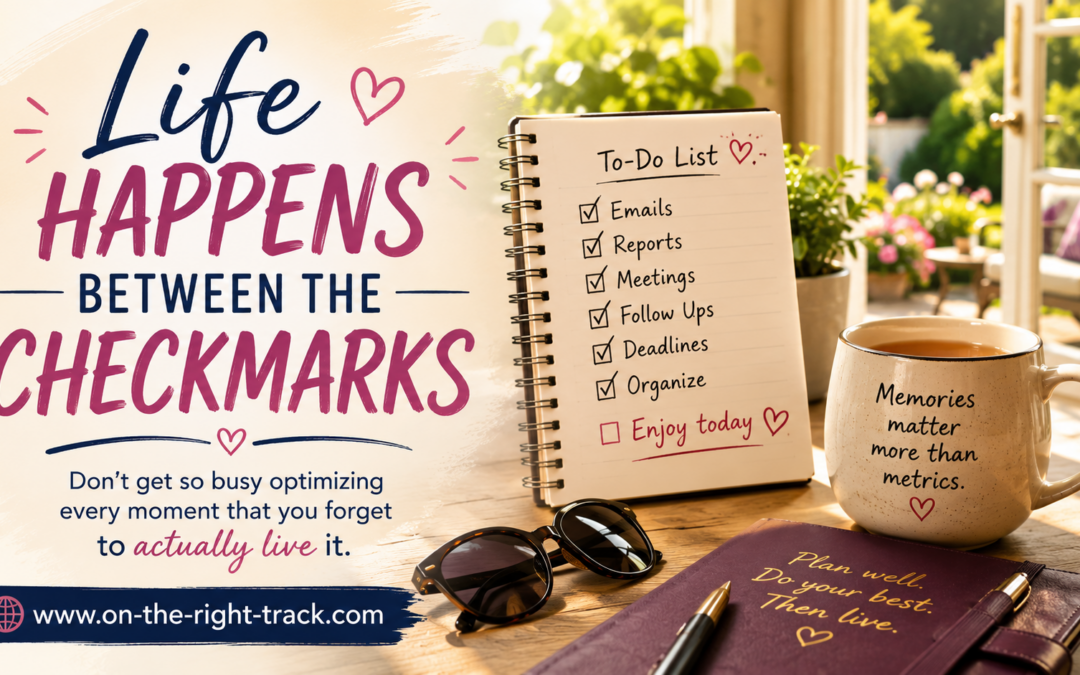
After all, when you look back years from now, you won’t remember the day you finally achieved Inbox Zero. You’ll remember the people you laughed with while there were still 147 unread emails waiting for you tomorrow. Because life happens between the checkmarks.

Rhonda Scharf, CSP, HOF, Global Speaking Fellow
Rhonda Scharf, renowned and award-winning speaker, author, consultant, and trainer is the “go-to” expert for the Administrative Professional and Executive Assistant community. With over 250,000+ trained across the globe, Rhonda is THE authority for fun and uplifting education for admins, because #ADMINSROCK!
Get in Touch
Phone
Ottawa: (613) 850-0350
Toll Free: 1 877 213- 8608
Address
7429 Carter Road
Kars ON K0A 2E0
Privacy / Terms of Service
Made with ♥ by Geneviève Rochon
I’m happy to say that I’m not the most-connected person in the world. I don’t have a smart watch, so I can answer when asked how I slept. 🙂 It is true that all of us could benefit from unplugging from technology a little more often.